
Spotify vs Licensed Business Music: What Businesses Need to Know
Compare Spotify with licensed business music solutions. Understand the differences between personal streaming services and commercial music platforms, including licensing, business features, and multi-location management.
June 10, 2026
Spotify has transformed the way people listen to music. With millions of songs available instantly, it has become one of the most widely used streaming platforms in the world.
For many business owners, Spotify is the first platform they think of when choosing music for their business. It is familiar, affordable, and offers access to millions of tracks. But is it the right solution for commercial environments? The answer depends on how your business operates, your growth plans, and the applicable licensing requirements in your country.
Because Spotify is affordable, familiar, and easy to use, many business owners naturally consider using it inside restaurants, cafes, retail stores, gyms, hotels, salons, and other commercial environments.

At first glance, the decision seems simple. Spotify offers a massive catalog, curated playlists, and an intuitive user experience. For a small business owner looking to improve atmosphere, it may appear to be the easiest option available.
However, businesses often have very different needs than individual listeners. Commercial environments involve customer experience, operational consistency, multiple locations, staff management, promotional messaging, and licensing considerations that go beyond personal music streaming.
This guide explores the key differences between Spotify and licensed business music solutions, helping businesses understand which option best fits their operational goals.
What Is Spotify Designed For?
Spotify is primarily known as a consumer music streaming platform. It was created to give individuals access to a vast library of music that can be streamed across phones, tablets, computers, smart speakers, and other personal devices.
Its success comes from delivering a highly personalized listening experience. Users can create playlists, receive recommendations, discover new artists, and listen to podcasts from almost anywhere.
Popular Spotify features include:
- personal music streaming
- personalized recommendations
- user-created playlists
- podcast streaming
- offline listening
- algorithm-driven discovery
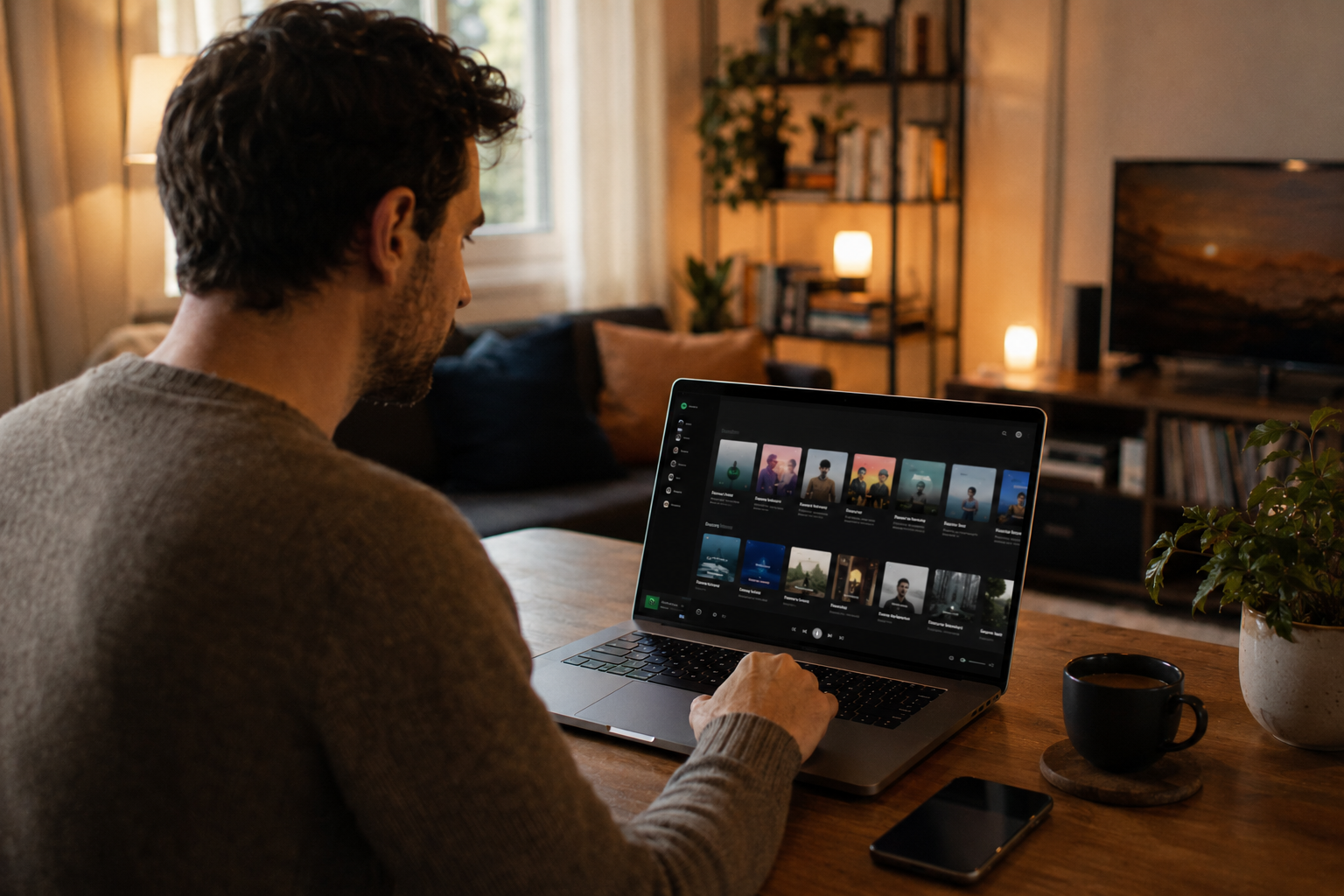
For personal entertainment, Spotify offers a powerful and convenient experience. It has become the default music platform for millions of consumers around the world.
The challenge for businesses is that commercial environments often require additional functionality that goes beyond personal listening.
Why Businesses Often Use Spotify
Many businesses begin using Spotify for one simple reason: it is already familiar.
Owners, managers, and employees frequently use Spotify in their personal lives, making it an obvious choice when they need music inside a commercial environment.
Common reasons businesses choose Spotify include:
- low monthly subscription costs
- large music catalog
- easy setup process
- staff familiarity
- playlist flexibility
- strong music discovery tools
For a single-location business, Spotify may initially seem like the simplest solution available.
For example, a small independent café that wants background music during opening hours may find Spotify convenient because staff already know how to use it and playlists can be created in minutes. For businesses with simple requirements and no need for centralized management, consumer streaming services may appear attractive at first.
As operational requirements become more complex, however, businesses often discover that convenience alone is no longer enough. Consistency, administration, compliance, and scalability become increasingly important.
A cafe owner might create a relaxing coffeehouse playlist. A restaurant manager may use jazz during dinner service. A retail store could build playlists that match seasonal campaigns.
From a usability perspective, Spotify is excellent at helping people find and enjoy music.
However, once a business grows or becomes more focused on consistency, additional challenges often appear.
Common Scenarios Where Businesses Play Music
Background music has become a standard part of customer experience across many industries.
Restaurants
Restaurants use music to create atmosphere, influence customer perception, and reinforce brand identity. Fine dining establishments often prefer calm and sophisticated playlists, while casual venues may use more energetic music throughout the day.
Music affects how customers experience a restaurant, helping the space feel premium, welcoming, energetic, or relaxed depending on the concept and the playlists used.
Cafes
Cafes frequently rely on carefully selected playlists to encourage longer visits and create a comfortable environment. Music often becomes part of the overall customer experience alongside coffee quality, interior design, and service.

Retail Stores
Retail businesses use music to shape shopping experiences. Different music styles can influence customer mood and support overall brand positioning.
Luxury retailers often prefer calm ambient playlists, while fashion stores may choose more energetic and trend-driven music.
Gyms
Fitness businesses frequently depend on music as a core part of the workout experience. High-energy playlists help support motivation, group classes, and overall member engagement.
Hotels
Hotels use music throughout guest journeys, from lobby areas and restaurants to wellness spaces and lounges. Music contributes to atmosphere and helps reinforce brand identity.
Commercial Music Use: Key Considerations
Listening to music at home and playing music inside a business are fundamentally different situations.
Depending on local licensing requirements, businesses may need additional permissions or commercial music solutions when music is played for customers, guests, or visitors. Requirements differ between countries, so business owners should always verify the rules that apply in their market.
A personal listening environment typically involves an individual or household enjoying music privately. Commercial environments, by contrast, often involve customers, visitors, guests, clients, or employees hearing music as part of a broader business experience.
This distinction is important because music use in commercial settings may involve additional considerations that do not apply to personal listening.
Commercial music use is generally understood as playing music in environments where customers, guests, visitors, or clients can hear it as part of the overall business experience. Unlike private listening at home, music in commercial settings becomes part of the service or atmosphere a business provides.
Licensing requirements vary depending on local regulations, the type of business, and how music is used. A neighborhood café, a hotel, and a retail chain may all have different operational requirements even if they are playing similar playlists.
For business owners, the goal is usually not to become experts in copyright law but to understand which solutions are appropriate for commercial environments. Choosing a platform designed for businesses can simplify day-to-day operations while helping organizations manage music more confidently.
This becomes particularly valuable as a business grows. What works for one location may not scale efficiently to multiple sites with different managers, operating hours, and customer demographics. A structured approach to music management helps businesses remain consistent while reducing administrative effort.

This can create complexity for business owners who simply want a reliable way to play music while focusing on running their operations.
For this reason, many businesses look for solutions that simplify music management while supporting commercial environments.
If you want to learn more about choosing music for commercial environments, see our complete Background Music for Business guide.
Challenges Businesses Face When Managing Music
Music management often becomes more complicated as a business grows.
A single-location cafe may only need one playlist and one device. However, a growing business may eventually face challenges such as:
- multiple locations
- different staff members controlling music
- inconsistent customer experiences
- changing promotions
- seasonal campaigns
- brand consistency requirements
Employee experience is another important consideration. Without clear playlist guidelines, staff may select music based on personal preferences rather than customer expectations. Over time this can create inconsistent experiences between shifts and locations.
Establishing clear music policies helps maintain brand consistency while reducing day-to-day management decisions for individual employees.
Without centralized control, different locations may create completely different customer experiences.
A restaurant chain that wants a consistent brand atmosphere may struggle when every location manages music independently.
This is one of the main reasons business-focused music platforms have emerged over the past decade.
Spotify vs Licensed Business Music
While Spotify and licensed business music platforms both provide access to music, they are designed with different goals in mind.
| Feature | Spotify | Licensed Business Music |
|---|---|---|
| Designed for personal listening | ✓ | ✗ |
| Designed for businesses | ✗ | ✓ |
| Business-focused onboarding | ✗ | ✓ |
| Multi-location management | ✗ | ✓ |
| Centralized control | ✗ | ✓ |
| Scheduled playlists | Limited | ✓ |
| Brand consistency tools | Limited | ✓ |
| Store-wide management | ✗ | ✓ |
| Business reporting tools | ✗ | ✓ |
| Commercial environment focus | Limited | ✓ |
| Promotional audio support | ✗ | ✓ |
| AI-generated voice advertising | ✗ | ✓ |
The most important distinction is that business music platforms are built around commercial operations rather than individual entertainment.
If you'd like to understand the broader principles behind commercial music licensing, read our Business Music Licensing: Complete Guide. It explains how business music licensing works, why licensing requirements can differ depending on your country, and what businesses should consider when choosing a commercial music solution.
Choosing the Right Solution for Different Business Types
The best choice depends on how your business operates today and how you expect it to grow in the future.
A small independent café with a single location may initially prioritize simplicity and ease of use. If music requirements are straightforward, a familiar consumer platform can appear attractive because employees already know how it works.
As businesses expand, however, priorities often change. A restaurant group with multiple locations may need consistent playlists, centralized administration, and the ability to schedule music automatically throughout the day.
Retail businesses frequently require music strategies that support seasonal campaigns, promotional events, and consistent brand positioning across every store. Hotels often manage several different audio environments simultaneously, including lobbies, restaurants, bars, wellness areas, and meeting spaces.
Fitness clubs face another challenge. Different areas of the facility may require completely different energy levels, making scheduled playlists and centralized management significantly more valuable than simple music playback.
Rather than asking whether Spotify or a business music platform is universally better, businesses should evaluate which solution best supports their operational needs, customer experience goals, and long-term growth plans.
Features Businesses Often Need
Music is only one part of managing customer-facing environments.
Many businesses eventually need tools that help maintain consistency across locations, teams, and customer experiences.
Common requirements include:
- centralized playlist management
- multi-location administration
- scheduling music by time of day
- brand consistency across locations
- remote management capabilities
- staff permission controls
Scalability is another important factor. A music solution that works well for one location should also support future growth without requiring businesses to completely change their operational workflow.
Many companies therefore evaluate music platforms not only for today's requirements but also for how well they support expansion into additional locations.

For growing businesses, these operational features often become more important than the music catalog itself.
A company with ten locations may care less about discovering new songs and more about ensuring every customer receives a consistent experience.
Music and Audio Advertising
Modern businesses increasingly use audio for more than background music.
Many companies also rely on promotional announcements, special offers, and in-store messaging to communicate with customers.
Examples include:
- restaurant lunch promotions
- retail sales announcements
- hotel guest information
- gym membership offers
- salon loyalty programs
- seasonal campaigns
Historically, producing professional audio advertisements required agencies, copywriters, voice actors, and audio production teams.
This process could be expensive and time-consuming for small businesses.

Today, AI-powered audio tools are making professional promotional content accessible to businesses of all sizes.
A store manager can describe an offer, choose a tone of voice, and generate professional audio content within minutes.
This represents one of the biggest changes in business audio technology over the last decade.
Why Businesses Choose Licensed Music Solutions
Businesses rarely choose dedicated music platforms simply because they want access to songs.
More often, they choose them because they want simplicity, consistency, and tools that support day-to-day operations.
Running a business already involves staffing, inventory, marketing, customer service, accounting, and countless operational tasks. Music should enhance the customer experience without creating additional administrative work.
Questions to Ask Before Choosing a Music Platform
Every business has different priorities, so selecting a music platform should begin with understanding your operational requirements rather than comparing music catalogs alone.
Before making a decision, ask yourself:
- How many locations does the business operate?
- Who will manage playlists?
- Should every location deliver the same customer experience?
- Will playlists need to change throughout the day?
- Do seasonal promotions require scheduled announcements?
- Is the business likely to expand in the future?
- How much day-to-day administration is acceptable?
Answering these questions helps narrow the selection to platforms that fit both current operations and future growth. For many businesses, ease of management and operational efficiency become just as important as the music itself.
Business-focused music platforms often help organizations:
- reduce operational overhead
- create consistent customer experiences
- manage multiple locations efficiently
- centralize audio administration
- combine music and messaging within one platform
Choosing the right platform is rarely about finding the largest music library. Instead, businesses should evaluate how well a platform supports daily operations, customer experience, staff workflows, and long-term growth.
For many organizations, operational efficiency ultimately delivers more value than additional entertainment features.
For many businesses, convenience becomes just as important as the music itself.
How EasyMusicLicense Differs
EasyMusicLicense is designed for businesses that want a simple, modern approach to managing background music and customer-facing audio across commercial environments.
Rather than focusing only on background music, the platform combines music management and audio marketing within a single environment.
EasyMusicLicense is designed to combine the capabilities businesses increasingly look for in a modern commercial audio platform, including:
- licensed background music
- business-focused music management
- simple subscription pricing
- commercial environment support
- playlist management tools
- multi-location scalability
- professional AI-generated voice advertising
- audio campaign creation tools
The goal is simple: help businesses manage their entire audio experience from a single platform.
Instead of using separate systems for music and promotional announcements, businesses can combine both within one workflow.
What Is the Future of Business Audio?
Business audio is evolving from a simple background feature into a strategic part of the customer experience. Companies are no longer using music solely to create atmosphere—they are increasingly combining music, customer communication, and marketing into a single audio strategy.
Cloud-based management is making business music easier to control than ever before. Instead of configuring each location individually, companies can manage playlists, scheduling, and audio settings for every site from a centralized dashboard. This reduces administrative work while helping maintain a consistent brand experience across multiple locations.
Artificial intelligence is accelerating this transformation. AI can recommend playlists based on business type, customer demographics, time of day, or seasonal campaigns. It also enables businesses to create professional promotional announcements, update in-store messaging quickly, and automate routine audio tasks that previously required significant manual effort.
As these technologies continue to mature, music and customer communication are becoming part of a unified business audio platform rather than separate operational tools. Businesses can coordinate playlists, promotional messages, and branded announcements from one place, improving operational efficiency while delivering a more consistent customer experience.
For business owners, this shift turns audio into a practical operational tool rather than a manual task, supporting brand consistency, customer engagement, and marketing execution as the business grows.
Frequently Asked Questions
Can I use Spotify in my business?
Businesses should review Spotify's terms, commercial usage considerations, and local licensing requirements before using consumer streaming services in commercial environments.
Is Spotify designed for commercial environments?
Spotify is primarily known as a consumer music streaming platform designed for personal listening experiences.
When might Spotify be suitable for a business?
Businesses with very simple music needs may initially choose consumer streaming services because they are familiar and easy to use. As operational requirements grow, many organizations move to platforms designed specifically for commercial environments.
What is licensed business music?
Licensed business music solutions are designed specifically for commercial environments and business use cases.
What is the difference between background music and business music?
Background music refers to music played within a space. Business music solutions often include additional management tools, operational features, and commercial-focused functionality.
How do I choose between Spotify and a licensed business music platform?
Consider how music supports your business today and how your needs may change as you grow. Businesses with multiple locations, centralized management requirements, or customer-facing audio campaigns often benefit from platforms designed specifically for commercial environments.
What should I look for when choosing a business music platform?
Consider commercial music support, ease of management, playlist scheduling, scalability, centralized administration, customer experience features, and the ability to support future business growth.
Can small businesses benefit from licensed music platforms?
Yes. Many small businesses value simplified management, consistent customer experiences, and integrated business-focused tools.
Can I manage multiple locations from one account?
Many business music platforms provide centralized management capabilities for organizations operating multiple locations.
Can I create promotional announcements with AI?
Modern platforms can generate professional promotional announcements using AI-generated scripts and realistic voice technology.
Conclusion
Spotify is an outstanding platform for personal listening, offering an enormous music catalog, intuitive playlists, and an excellent user experience for individual consumers.
Business environments, however, have different priorities. As companies grow, they often need centralized management, consistent customer experiences, playlist scheduling, and tools designed specifically for commercial operations.
The right choice depends on your business rather than the size of a music library. A single-location business with simple requirements may prioritize familiarity and ease of use, while growing organizations often benefit from platforms built for commercial environments and long-term scalability.
By understanding the differences between consumer streaming services and licensed business music platforms, you can choose a solution that supports your customer experience, simplifies daily operations, and grows alongside your business.
Start using licensed music and AI-powered audio ads in your business
Explore a modern platform for licensed background music and AI-powered audio advertising.
Start Free TrialGet your music license today
Start playing licensed music in your business in under 5 minutes.
View Pricing